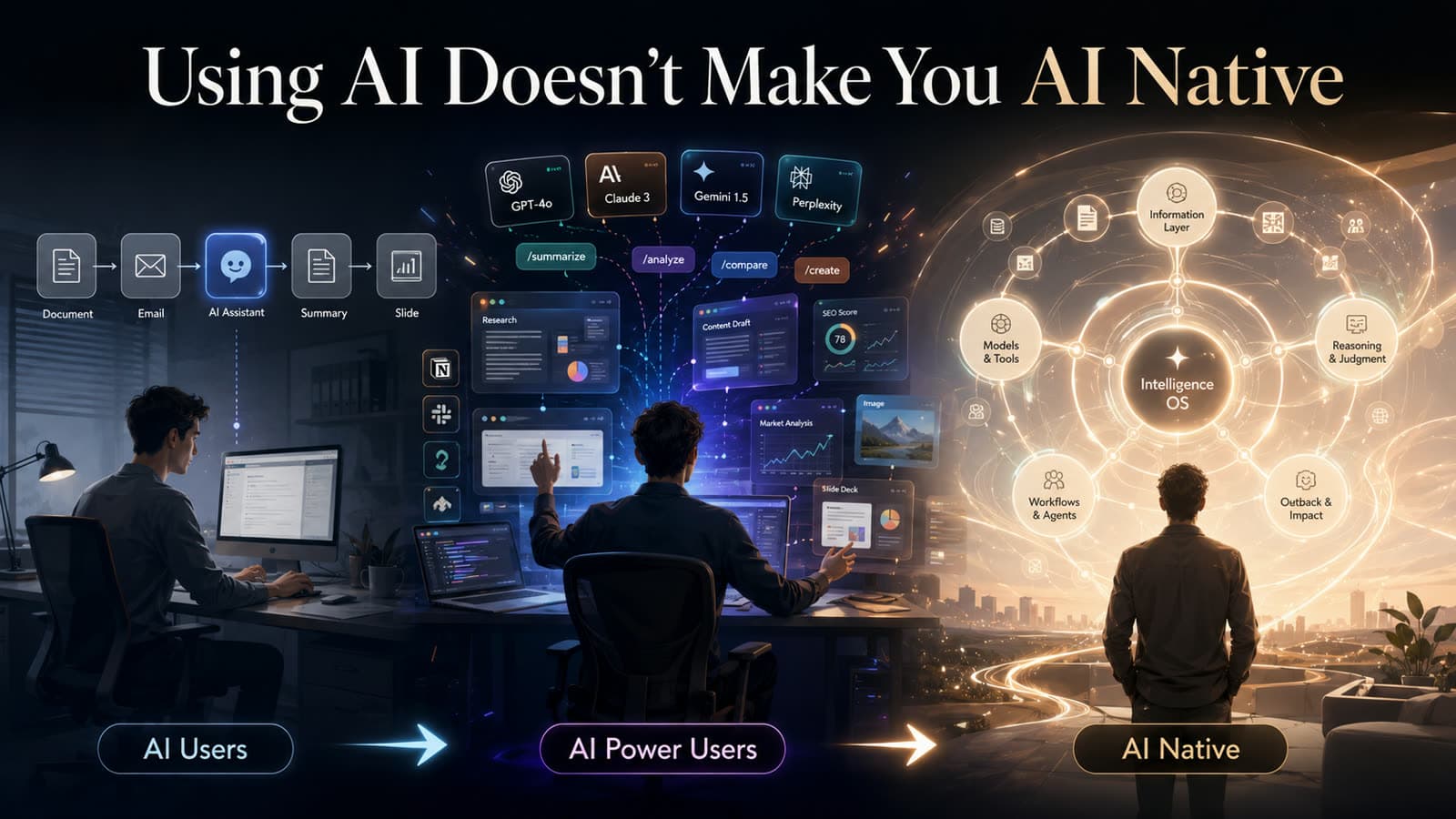
Using AI Doesn't Make You AI Native
Many people define "AI Native" too loosely.
If we use ChatGPT every day to write emails, summarize documents, or polish slides, that is progress. But it does not automatically make us AI Native.
The real dividing line is not how much AI we use, but whether we have made AI part of our working system.
Three Groups of AI Users
I would roughly divide people into three groups.
- The first group is AI Users. Use AI as a faster tool: help me rewrite this paragraph, translate this email, summarize this document. The task remains the same. The workflow remains the same. AI is simply added as an assistant in the middle.
- The second group is AI Power Users. Know many models and tools. Understand how to write better prompts. The output is often faster, cleaner, and more polished. But many Power Users still operate in the mode of "human directs machine to complete isolated tasks." Every task still needs to be re-asked, re-tuned, and re-contextualized.
- The third group is what I would call AI Native. AI Native people are not those with the longest list of tools. They are people who can combine fragmented models, tools, prompts, and workflows into a system that keeps improving.
What AI Native People Ask
They are not only asking: "How can I use AI to do this task faster?"
They are asking: "In this workflow, which judgments must remain human? Which parts of information processing can be handled by machines? Which processes should be systematized instead of manually repeated every time?"
That is the real difference.
Still a Tool User
Someone who uses ChatGPT ten times a day may still be only a tool user. Because their work structure has not changed: the human is still the only operating center, and AI is just a temporary outsourced brain.
Redesigning the Division of Labor
The real shift of AI Native is that they redesign the cognitive division of labor between themselves and machines. Humans define the problem, judge value, set boundaries, and make final trade-offs. Machines organize information, identify patterns, generate first drafts, explore options, and execute repeatable workflows.
More importantly, this division of labor is not one-off. It gets captured, reused, and improved over time.
System Migration Capability
So the essence of being AI Native is not all tool fluency. It is system migration capability. It is the ability to migrate one's experience, judgment, and working methods into an AI-assisted system.
This is also how I am trying to train and rebuild myself — not just by using AI more, but by practicing an AI-native way of working.
Takeaways
The real dividing line is not how much AI we use, but whether we have made AI part of our working system.
It is the ability to migrate one's experience, judgment, and working methods into an AI-assisted system.
This is also how I am trying to train and rebuild myself — not just by using AI more, but by practicing an AI-native way of working.
Was this useful?